The Business Research Company’s Waste To Energy Global Market Report 2026 – Market Size, Trends, And Forecast 2026-2035
LONDON, GREATER LONDON, UNITED KINGDOM, October 28, 2026 /EINPresswire.com/ — The waste to energy sector is rapidly evolving as global efforts to manage waste sustainably and generate renewable energy intensify. With growing urbanization and stricter environmental regulations, this market showcases significant potential for expansion. Let us explore the current market outlook, growth drivers, key players, and emerging opportunities shaping the waste to energy industry.
Waste to Energy Market Size and Forecast Highlights
Projected to surpass $59 billion by 2030, the waste to energy market represents a notable segment within the broader power generation industry, which is expected to reach about $2,795 billion by the same year. Waste to energy accounts for roughly 2% of power generation and approximately 0.6% of the Utilities sector’s estimated $9,379 billion value. The sector is anticipated to grow at a steady compound annual growth rate (CAGR) of 8% through 2030, driven by technological advancements and increasing demand for sustainable energy solutions.
Request A Free Sample Of The Waste To Energy Market Report
https://thebusinessresearchcompany.com/sample_request?id=8797&type=smp&name=Waste%20To%20Energy%20Market%20Report%202026&utm_source=EINPresswire&utm_medium=Paid&utm_campaign=Oct_PR
Municipal Solid Waste Segment Leads Waste to Energy Growth
By 2030, municipal solid waste is forecasted to be the dominant segment in the waste to energy market, making up 52% of the market share with a value of $31 billion. This growth is supported by innovations such as smart city waste collection systems and the expansion of high-efficiency combustion and gasification technologies. The competitive landscape includes global energy firms and specialist environmental technology providers focusing on thermal and biological conversion methods, emissions control, and integrated waste processing facilities. Core to their strategies are circular economy principles, stringent environmental regulations, carbon reduction goals, and sustainable waste handling practices.
Asia-Pacific Emerges as a Key Regional Market for Waste to Energy
Asia-Pacific is poised to be the largest regional market for waste to energy in 2030, valued at $24 billion, up from $16 billion in 2025, with a CAGR of 9%. This rapid growth reflects urbanization trends producing more municipal solid waste, policy support for renewable energy and sustainable waste management, investments in waste-to-energy plants and district heating systems, and limited landfill availability in densely populated countries. Countries such as China, Japan, India, South Korea, and Southeast Asian nations lead this expansion through public-private partnerships and adoption of advanced thermal and biological conversion technologies.
Access The Detailed Waste To Energy Market Report Here
https://thebusinessresearchcompany.com/report/waste-to-energy-global-market-report?utm_source=EINPresswire&utm_medium=Paid&utm_campaign=Oct_PR
China’s Dominance in the Waste to Energy Market
China is expected to be the leading country in the waste to energy market by 2030, with a market size of $11 billion, growing from $7 billion in 2025 at a CAGR of 9%. The nation’s growth is fueled by ambitious circular economy mandates, large urban incineration facilities, strong landfill diversion targets, integration of waste-to-energy projects with district heating and industrial steam generation, enhanced municipal waste segregation infrastructure, and substantial government policy and financing support for environmental infrastructure development.
Renewable Energy Shift as a Major Growth Catalyst
A primary driver behind the waste to energy market’s expansion is the global transition toward renewable energy sources. Governments worldwide are accelerating efforts to reduce carbon emissions and fossil fuel dependency, promoting waste-to-energy plants that not only produce electricity and heat but also minimize landfill use. These renewable energy targets, supported by favorable policies and carbon reduction initiatives, are expected to contribute approximately 0.9% annual growth to the market.
Urbanization Pressures Driving Waste to Energy Demand
Rapid urban population growth is another significant factor fueling market expansion. Increased urbanization results in greater volumes of solid waste, placing pressure on municipal waste management infrastructure. Waste-to-energy technologies offer a practical solution by converting waste into valuable energy, helping cities manage limited landfill space effectively. This urbanization trend is projected to add around 0.9% annual growth to the waste to energy market.
Waste Management Efficiency Enhances Market Growth
Governments and municipalities are increasingly focused on implementing efficient waste management systems to reduce landfill reliance, recover resources, and comply with environmental regulations. Waste-to-energy processes, which treat non-recyclable waste while lowering environmental impacts, are becoming essential components of these systems. This emphasis on improved waste management is expected to contribute roughly 0.7% annual growth to the market.
Market Segments Projected to Add Substantial Value
Among waste types, municipal solid waste, agricultural waste, and other miscellaneous waste segments are set to drive the most significant growth, collectively adding more than $18 billion in market value by 2030. Municipal solid waste alone is anticipated to grow by $9 billion, agricultural waste by $5 billion, and other waste types by $4 billion between 2025 and 2030. This expansion is supported by advancements in thermal conversion technologies such as gasification and pyrolysis, decentralized and modular plant development, bioenergy production from organic waste, integrated processing hubs near industrial and peri-urban zones, long-term renewable power purchase agreements, and technologies focused on carbon reduction and landfill diversion.
Breakdown of Waste to Energy Market by Type and Application
The waste to energy market is segmented based on the type of waste processed—namely municipal solid waste, agricultural waste, and other waste categories. It is also categorized by technology, including thermal, biochemical, and other treatment methods. Additionally, applications are divided into heat production and electricity generation.
Decentralized Biogas Systems Advancing Waste to Energy Solutions
Decentralized anaerobic digestion systems are revolutionizing the sector by efficiently converting organic waste into renewable biogas and organic fertilizers, significantly reducing landfill dependence. For example, in June 2026, Kirloskar Pneumatic Company Limited introduced ‘Tonalli,’ a decentralized waste to energy solution that processes organic food waste into biogas and fertilizer. Features such as controlled anaerobic digestion, biogas agitation, multi-stage purification, and pressurized gas delivery enhance energy recovery, improve safety, and promote sustainable waste management practices.
Competitive Landscape and Market Fragmentation
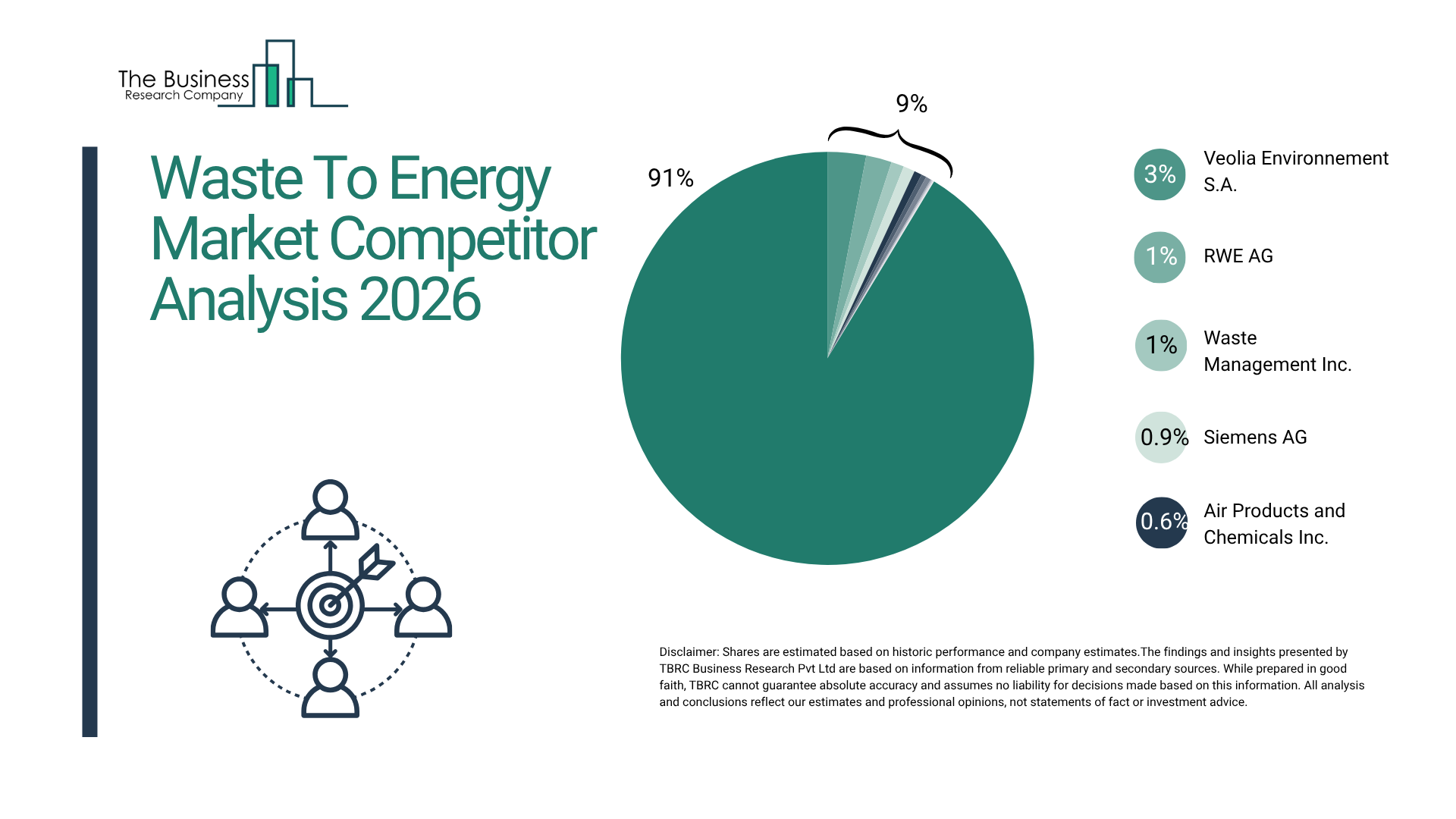
The waste to energy market remains fragmented, with the top 10 companies accounting for only 9% of total revenue in 2025. Barriers to entry include strict environmental standards, complex technologies, high capital requirements, and stringent emissions controls. Leading firms maintain notable shares through diversified service offerings, partnerships with municipal and industrial clients, global project execution, and ongoing innovation in energy recovery and processing. As demand for advanced, low-emission waste-to-energy solutions grows, companies are expected to strengthen their positions through collaborations, technological breakthroughs, and regional expansion.
Market Share Leaders and Their Focus Areas
Veolia Environnement S.A. leads the market with a 3% share in 2025, followed by RWE AG with 2%, and Waste Management Inc., Siemens AG, and Air Products and Chemicals Inc. each holding about 1%. Other significant players include Remondis, A2A S.p.A., Enerkem Inc., Babcock & Wilcox Enterprises Inc., and Tetra Tech. These companies concentrate on enhancing waste-to-energy conversion technology, combining thermal and biological treatment methods to increase energy efficiency, growing decentralized infrastructure, and integrating AI-based monitoring for better performance and emissions control.
Veolia’s Dominant Position in Waste to Energy
According to The Business Research Company, Veolia Environnement S.A. ranks first globally in sales within the waste to energy sector, with a 3% market share in 2025. Its operations include waste treatment, energy recovery, incineration technology, landfill gas utilization, and comprehensive environmental services catering to municipal waste, industrial processing, and renewable power generation.
Key Players Across the Waste to Energy Value Chain
The market ecosystem involves raw material suppliers such as Veolia Environnement S.A., Suez S.A., Waste Management Inc., Covanta Holding Corporation, Mitsubishi Heavy Industries Ltd., and others. Wholesalers and distributors include major industrial and energy companies like Alfa Laval AB, Siemens Energy AG, GE, Schneider Electric SE, and Caterpillar Inc. End users span a variety of municipal and governmental bodies, including city waste authorities, environmental agencies, sanitation departments, and energy recovery facilities across multiple regions. These stakeholders collectively drive the development, adoption, and operation of waste to energy technologies and infrastructure worldwide.
New analytical features added to our 2026 market reports:
• Market attractiveness scoring and analysis
• Total addressable market (TAM) analysis
• Company scoring matrix graphics and tables
• Excel-based forecasting dashboards
• Market hotspots infographics
• Key technologies and future trend analysis
• Updated graphics and tables
Learn More About The Business Research Company
The Business Research Company (www.thebusinessresearchcompany.com) is a leading market intelligence firm renowned for its expertise in company, market, and consumer research. We have published over 30,000+ reports across 27 industries and 60+ geographies. Our research is powered by 1,500,000 datasets, extensive secondary research, and exclusive insights from interviews with industry leaders.
We provide continuous and custom research services, offering a range of specialized packages tailored to your needs, including Market Entry Research Package, Competitor Tracking Package, Supplier & Distributor Package and much more.
Disclaimer: Please note that the findings, conclusions and recommendations that TBRC Business Research Pvt Ltd delivers are based on information gathered in good faith from both primary and secondary sources, whose accuracy we are not always in a position to guarantee. As such TBRC Business Research Pvt Ltd can accept no liability whatever for actions taken based on any information that may subsequently prove to be incorrect. Analysis and findings included in TBRC reports and presentations are our estimates, opinions and are not intended as statements of fact or investment guidance.
Contact Us:
The Business Research Company
Americas +1 310-496-7795
Europe +44 7882 955267
Asia & Others +44 7882 955267 & +91 8897263534
Email: marketing@tbrc.info
Follow Us On:
LinkedIn: https://in.linkedin.com/company/the-business-research-company
Oliver Guirdham
The Business Research Company
+44 7882 955267
info@tbrc.info
Visit us on social media:
LinkedIn
Facebook
X
Legal Disclaimer:
EIN Presswire provides this news content “as is” without warranty of any kind. We do not accept any responsibility or liability
for the accuracy, content, images, videos, licenses, completeness, legality, or reliability of the information contained in this
article. If you have any complaints or copyright issues related to this article, kindly contact the author above.

Media gallery