
Key Takeaways
- Disabled households in the UK face an average of £1,095 extra per month just to achieve the same standard of living as non-disabled households, creating a real and pressing financial gap.
- UK disability benefits like PIP, Universal Credit and ESA each have different rules around earned income – there is no single “safe” earnings figure that applies to everyone.
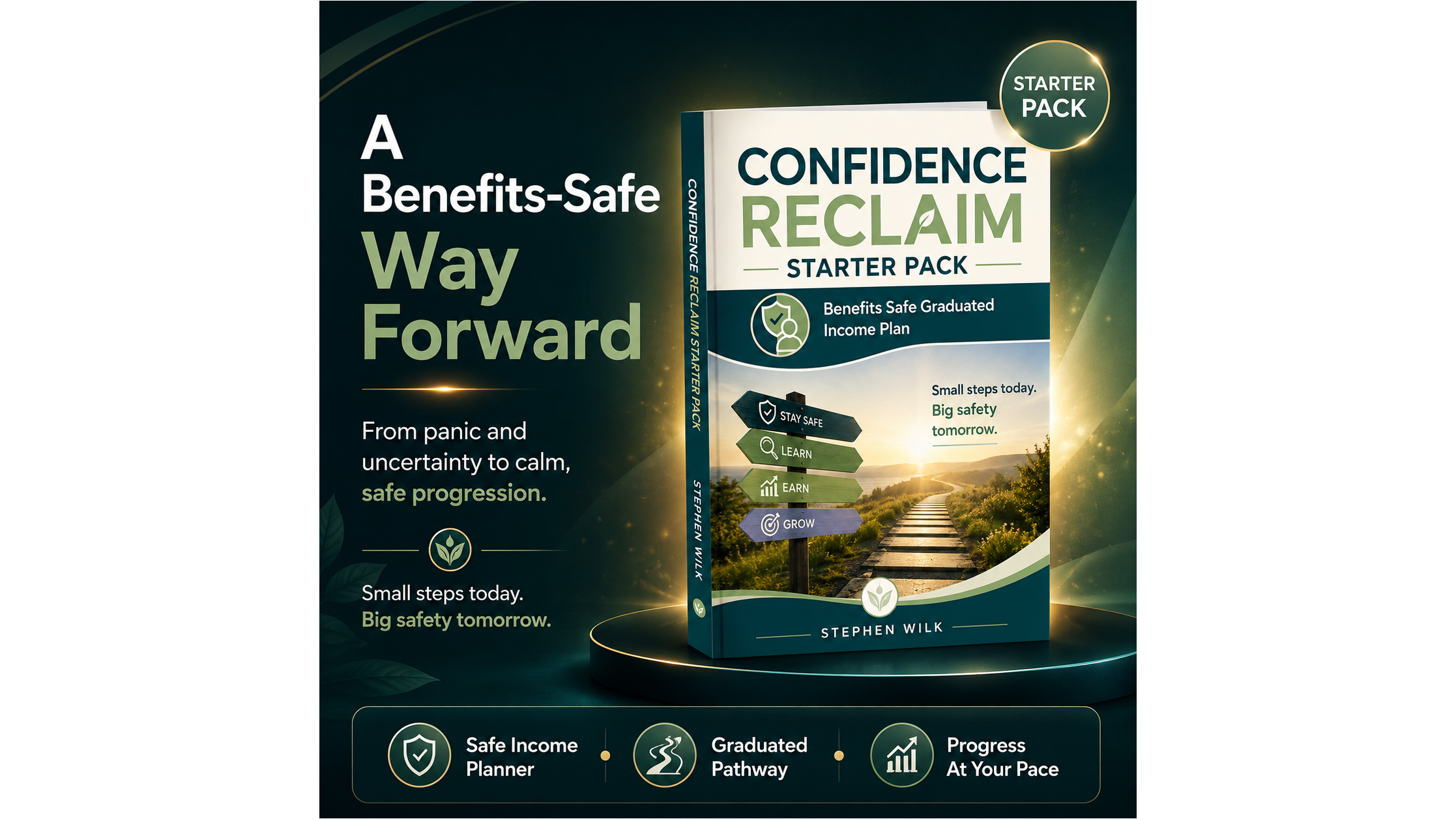
- The Confidence Reclaim Starter Pack is built around understanding your personal benefits position first, before introducing any income opportunity – an approach that sets it apart from generic advice lists.
- The Starter Pack is not suitable for everyone – it is specifically for those who already want to consider change and need a structured, low-pressure starting point.
- Inside the course, tools like the Safe Income Planner and Graduated Income Plan help users think in measured steps, not all-or-nothing decisions – a distinction worth understanding before choosing any income route.
For many disabled people and those with long-term health conditions in the UK, the desire to earn a little extra sits alongside a very reasonable fear: what if it affects my benefits? That question deserves a proper answer – not a vague reassurance, and not a wall of government guidance that leaves the personal question unanswered. This piece breaks down what the Confidence Reclaim Starter Pack actually is, who it is designed for, and how it approaches the income and benefits challenge in a way that most generic resources simply do not.
Disabled People in the UK Face a £1,095 Monthly Gap – And Benefits Rules Make Earning Feel Risky
Research by the disability charity Scope in 2025 found that disabled households in the UK face, on average, £1,095 in extra costs every month compared to non-disabled households just to reach the same standard of living. That figure reflects the compounded cost of adapted equipment, specialist transport, higher energy use, and care – expenses that do not disappear when income is limited.
Yet for many people receiving disability benefits, the idea of earning anything extra comes loaded with anxiety. The rules around what you can earn, when you must report it, and how it might affect your payments are genuinely complex – and the consequences of getting it wrong can feel catastrophic when those payments cover essentials.
That combination – financial pressure on one side, and fear of losing support on the other – is exactly the gap that the Confidence Reclaim Starter Pack was built to address. Not by dismissing the risks, but by helping people understand their own position clearly before taking any step forward.
What the Starter Pack Actually Is
A Pathway, Not a List of Ideas
The Confidence Reclaim Starter Pack is a guided course and set of planning tools, structured around a two-stage approach: first, understand your own benefits position; second, begin working through a specific flexible online income opportunity via a step-by-step setup process.
What separates it from most disability income content is the sequencing. The income opportunity is not introduced until the user has worked through their personal planning. The aim is to replace rushed, anxious decisions with a slower, more deliberate process – one that suits people whose health means they cannot always guarantee the same capacity from one day to the next.
Why Benefits Planning Comes First
Many resources explain benefit rules at a general level. What they rarely do is help someone translate those rules into a personal picture of their own situation. The Starter Pack uses two tools – the Safe Income Planner and the Graduated Income Plan – to bridge that gap. Together they help users organise what they know about their current circumstances and think through income in stages, rather than treating it as a single high-stakes decision.
These are planning tools, not official benefits advice. Users are guided to check conclusions with an appropriate adviser before making any decisions that could affect their payments.
Who It Is Designed For
Health That Changes Day to Day
The Starter Pack was built with fluctuating health in mind. Many disabled people cannot commit to fixed hours, promise consistent output, or fit neatly into the structure that most employment or business opportunities assume. The course can be worked through in sections, at the user’s own pace, with no deadline or fixed timetable. The opportunity it introduces is primarily online, requiring no physical demands, specialist equipment, or prior business experience.
The Starter Pack is likely a good fit when:
- You have a disability or long-term health condition and are receiving UK disability-related benefits
- Fixed hours or conventional employment are difficult due to pain, fatigue, anxiety or fluctuating capacity
- You want to consider additional income but feel uncertain about what is safe to do
- You have ambition but do not consider yourself naturally business-minded
- You feel overwhelmed by the amount of information involved and want a structured starting point
Who It Is Not For
The Starter Pack is not designed to persuade someone who does not want to consider earning income. It makes no promise of guaranteed earnings, and it does not guarantee that benefits will remain unchanged. It is not a replacement for qualified welfare rights, legal, financial or tax advice.
It is also not a quick path to financial independence. Results will depend on individual circumstances, available time, and the actions a person takes. Anyone expecting an instant or passive outcome is likely to be disappointed.
How UK Benefits Interact With Extra Income
PIP, Universal Credit and ESA: Key Differences
The three benefits most likely to be relevant to Starter Pack users each work differently around earned income.
Personal Independence Payment (PIP) is not means-tested. Earned income does not directly reduce a PIP award. However, work activity that appears inconsistent with the nature of a claim could become relevant during a review – so it is not entirely separate from income decisions.
Universal Credit (UC) is means-tested and applies a taper system. For most claimants, UC reduces by 55p for every £1 earned above the applicable work allowance. That allowance varies depending on household circumstances, including whether housing support is included in the claim.
Employment and Support Allowance (ESA) has its own framework. Under permitted work rules, claimants can generally work fewer than 16 hours per week and earn no more than £203.50 per week (2026/27 figures) after tax and National Insurance. Exceeding either threshold can affect the award.
Why There Is No Single Safe Earnings Figure
Even with those headline rules understood, the specific impact on any individual will depend on their exact benefit combination, household composition, existing award levels, and whether income comes from employment or self-employment. That is why the Safe Income Planner does not attempt to produce a universal answer – it prompts the right questions for a specific person’s situation.
What Is Inside the Starter Pack
The Safe Income Planner and Graduated Income Plan
These two tools form the core of stage one. The Safe Income Planner helps users organise information about their current position and consider how additional income might interact with it. The Graduated Income Plan encourages thinking in smaller incremental steps – reviewing what is happening at each stage before scaling further. This approach is particularly valuable for anyone whose instinct is to treat income planning as a binary choice between doing nothing and doing everything at once.
The Prediction Trap Free Lesson
Before any planning begins, the Starter Pack opens with a free introductory lesson called The Prediction Trap. Designed for people who feel stuck, cautious, or afraid of losing something they depend on, the lesson explains how the mind can treat feared outcomes as established facts and introduces practical ways to separate a forecast from evidence. It is a calm entry point – addressing the psychological barrier before the practical one.
Beyond these, the course also includes a Confidence Roadmap, practical setup guidance for the income opportunity, an Access to Work grant assessment tool (which guides users through questions about potential eligibility for government-funded support with disability-related work costs), and a Confidence Scripts and Reassurance Library for moments when uncertainty starts to interrupt progress.
How It Compares to Other Income Options
Someone considering extra income might also look at surveys, freelance services, reselling, blogging, or remote employment. Any of these could be suitable depending on the person. The more useful comparison, though, is not simply which option could earn the most – it is which option actually fits the person’s life.
Comparison Questions – The Confidence Reclaim Approach
Can it fit around changing health? The pathway is self-paced with no fixed schedule Is a new business idea required? Existing offers within the platform can be reviewed first
Does it include benefits planning? The Safe Income Planner and Graduated Income Plan come before any income activity
What physical demands are involved? The opportunity is primarily online
Is specialist experience required? The course explains the process from the beginning, assuming no prior background
Schemes like the Access to Work grant can also help cover costs associated with self-employment for disabled people – from specialist equipment to support workers – and the Starter Pack includes a tool to help users assess whether it may be relevant to their situation.
The Starter Pack Turns Information Into a First Step You Can Actually Take
A great deal of disability income content stops at information. General rules are explained, possible income types are listed, and the reader is left to work out what any of it means for their specific situation. That gap – between general information and personal action – is where many people stay stuck.
The Confidence Reclaim Starter Pack is structured to close that gap. Understanding connects with movement: the relevant questions are organised, a specific opportunity is introduced at the right moment, and the user is guided through the setup steps needed to actually begin. The course takes approximately one hour to complete and can be broken into sections to suit available energy and time.
Information tells you that options exist. A pathway helps you take the next step.
To find out how Confidence Reclaim supports disabled people and those with long-term health conditions in building income safely and confidently, visit confidencereclaim.co.uk.
Confidence Reclaim
23 Sportside Avenue
Manchester
Greater Manchester
M28 3NP
United Kingdom


